The Case for Decentralized Connected Learning (Part 1: Teaching & Learning Without Regulation?)

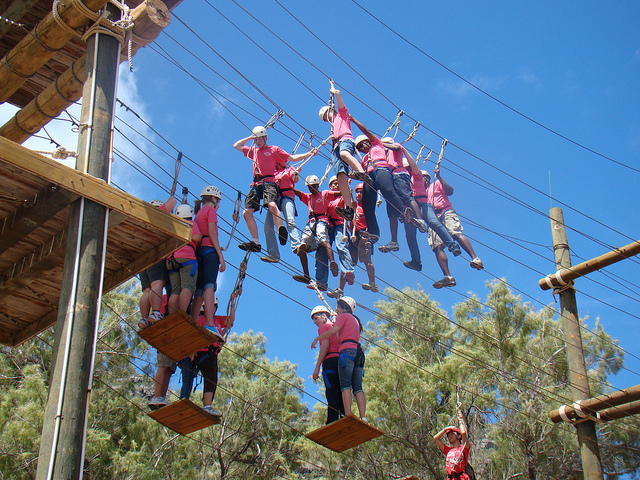
Group of people ziplining

Since the future of learning is a hot topic these days (it’s about time), I wanted to write a personal and community development perspective about some of the positive side effects that have been documented by individual adult participants in communities who have created or used systems to connect informally to learn from each other.


However, as I started to write, it became evident that I couldn’t get far without addressing the elephant in the room that is credentialing.


This is not a commentary on institutions or traditional learning, and should not be looked at in “either, or” terms.  Rather, the focus is on “why not?”, and looking at the positive benefits of encouraging institutional education, while also encouraging people to access each other as individuals to obtain skills and knowledge for  personal growth and take learning into their own hands.


When we started the LRNGO, we got some pushback about credentialing.  At one of our forums, someone even said, “People can’t just teach and learn from each other without regulation.  My mother is a teacher!”  I found this ironic, since teaching is the very behavior we were trying to promote.  However, I also understood that the idea of teaching and learning taking place without certification might be a foreign concept to those who only think of the word “teacher” in the context of classroom management or formal education.


While I am quick to agree that I would prefer certified training before a doctor opens me up for heart surgery or before an attorney represents me in a court of law, I also believe that, as a student or learner, there are many instances where I am capable of assessing whether or not I have benefited from a class, course, or private instruction in which I have participated.  I’m also sure I’m not the only one who has ever received a certificate that I would have given back in return for the cash I paid.  So in the case where learners and students are looking for results rather than a badge or degree, above all else, shouldn’t their perception of those results matter?


Rather than arguing whether credentials are always necessary, what if we focused on whether learner feedback is helpful—not just for other prospective learners, but also for the instructor?  It’s worth arguing whether evaluation should be based solely on the perception of the participants, but it may be worth arguing whether it should be based solely on certificates and credentialing as well.  They are both simply indicators of knowledge received, the results of which are then measured in multiple ways dependent on many variables.


I have also heard the argument that learning without credentials is a “waste of time,” as if the lack of a credential somehow makes the skill less actionable. Learning can be actionable or not actionable depending on what you do with the knowledge afterwards. So if knowledge is power, is it a waste of time to be empowered simply because the result didn’t come with a badge?

In many cases, we are told that the end result of the credential is more important than the knowledge itself. For instance, we often hear the statement “studies show people are twice as likely to earn more money if they have a credential or degree. This statistic sounds true enough until you look at it in context. If you consider the demographics of US college students before they attend, you see the majority were already twice as likely to earn more money because most of them started with more resources, which was how they got into college in the first place.  It’s a lot like saying, “studies show people who have money worry less,” and using it as a selling point.


Regardless of whether statements like these are true or simply made by those who have a vested interest, it’s hard to argue that credentials have not traditionally been a means for perpetuating inequity (ie: mostly available to those who can afford them).


The point here is not that credentials can’t have value, but wouldn’t it be empowering for everyone at all income levels if we knew who around us at any given time possessed the expertise we needed and was willing and able to help us learn?  What would happen if this were the case in every community, city, country, or even the world?  That’s the question a couple of college students asked in Chicago in 1971, and the answer they found is as relevant today as it was then.


“The operation of a peer-matching network would be simple. The user would identify himself by name and address and describe the activity for which he sought a peer. A computer would send him back the names and addresses of all those who had inserted the same description. It is amazing that such a simple utility has never been used on a broad scale for publicly valued activity.”

    — “Deschooling Society” by Ivan Illich 1971


Read part 2 The Case for Decentralized Connected Learning (Part 2: The Learning Exchange).


Contact us to volunteer or Donate and help the LRNGO worldwide directory become a community.


Photo Credit: U.S. Army

Friendships From Across the World

Cheers Friends Drink Wine

Photo Credit: Didriks

While many LRNGO users meet to learn from each other locally in the same city, or even from a neighbor down the street, others choose to make their community much wider and go around the world. Of course, this requires using a live video chat platform, like Facetime, Google Hangouts or Skype.

One of the things you may find interesting though, is that even among those LRNGO users using video chat, the percentage who prefer to learn from each other remotely when they have a choice is still the minority. When given the choice, roughly 75% of you prefer to list meeting in-person rather than online.

This reminds us that for the majority, although technology is used to facilitate, in the case where you have a choice, face to face is preferable. At the end of the day, learning from each other (especially one-to-one) is most often still a very traditional in-person proposition.

Along those lines, some of you who are Skyping each other from afar for language exchange specifically may be interested in eventually meeting in person if it can be arranged. While facilitating these arrangements directly is beyond the scope of the introductory services we provide through LRNGO, you may be interested to know that there is now a website and online platform doing this.

Launched just last month, TalkTalkBnb is a social network for learning languages from local hosts while traveling. The idea is that travelers receive complimentary food and lodging from hosts (people wanting to improve their language skills) in exchange for helping the hosts learn and practice the traveler’s native language throughout their stay.

We all know that language exchange is valuable for accelerating the learning process and is the most cost effective way to receive the benefits of one-to-one language tutoring, but now it can also be used as a means of “currency” for your travels. That’s a real win/win.

You can find out more here, and hopefully some of you who have met here on LRNGO and are now practicing language exchange remotely can have the opportunity to travel and meet in person by bartering for accommodations. It’s a pretty cool concept that we hope takes off around the world.

We Are ALL In the Education Business

In the late 90’s, I finally got my first cellphone. I fought it for years.
Learn to Swim from Peers

Photo Credit: Frits Ahlefeldt-Laurvig

The idea that I would be on the phone during my quiet time or drive time talking (and probably working) did not appeal to me in the least. Sure there were social benefits, but I wanted time to recharge, unplug, meditate, and collect my thoughts.  In short, I wanted down time.  Fast forward to 2014.

Now, it would be almost impossible to live without this device.  Why is that? (Long live down time, rest in peace.)

Ask yourself: have you ever gone a day without your smartphone or mobile device?  If you unplugged from the net and social media, how long would you last–two days perhaps, a week?

Let’s make this a multiple choice question.

With no mobile device, would you feel:

A. Isolated
B. Uninformed
C. Vulnerable
D. All of the above

For many, the answer is D.

In the end, I needed a cellphone because I couldn’t wait to know things any more.  I needed to reach people wherever I was, at times to keep in touch for social reasons, but more often to get things done or grab a quick update from someone to assess and learn what needed to be done next.

As I write this blog, I’m finding it interesting that there are some keywords I just can’t avoid.  This is not for SEO purposes (sorry Google), but rather because I can only describe what I’m saying by using these words and they keep popping up.  Do you see a pattern yet?

The fact is, I can’t talk about connecting with other people without using the words “know” and “learn.” (Well whaddaya know?)  If you think about it (“think”–there’s another one), it’s engrained in our social language.

In fact, I hate to admit it, but it’s no longer just me on the continuous learning bandwagon.  How many times have you seen the word “webinar” in your email box lately?  There sure seem to be a lot of free classes these days.  And how many seminars have you gone to this year?  It seems like a lot of expense to put those on, doesn’t it?

I went to a couple of free business strategy meetings and M&A seminars earlier this year, and I learned a lot.  I’m not being facitious, I really did.  It was a valuable experience, and I couldn’t help being struck by how much they had to educate me in order for me to become their future customer.  And that’s when it hit me:

We are all in the education business now.  Every one of us.

Whether you’re educating your future customers, current customers, peers, co-workers, employees, investors, the press, the general public, or friends and family; if you want to stay relevant, people need to understand what you’re doing, how it works, and why it’s important.  Things are moving too fast for people to pay attention to anything if they don’t understand its value.

I also equate this idea with the reason we received so many questions recently at Lrngo from users wanting to know how to promote their expertise and themselves as speakers; which became the subject of two Lrngo blogs earlier this year.  So many people with expertise wanted to gain speaking experience and promote themselves by giving presentations, webinars and classes on their topics, that we had to dig in and come up with the information.

This trend isn’t as much about 15 minutes of fame as it is about survival of the fittest.  The consultant, service provider or company that doesn’t stay ahead of the curve by educating their target market on why they are needed and what makes them different won’t be around very long.

As we shift to the reputation economy and social media shines the spotlight on the expertise of individuals, the move toward constantly educating and re-educating each other is not likely to subside any time soon.  In the words of Denis Waitley, “<you can> never become so much of an expert that you stop gaining expertise.”  You have to stay ahead of the curve.

In late 2014, I finally joined Twitter. I fought it for years. It’s amazing how much you can learn from one sentence.

Follow me on Twitter @davidcbrake